Facebook Marketplace Scams UK: Payment & Collection
Avoid Facebook Marketplace scams UK buyers and sellers face with safer payment choices, collection checks and recovery steps if things go wrong.
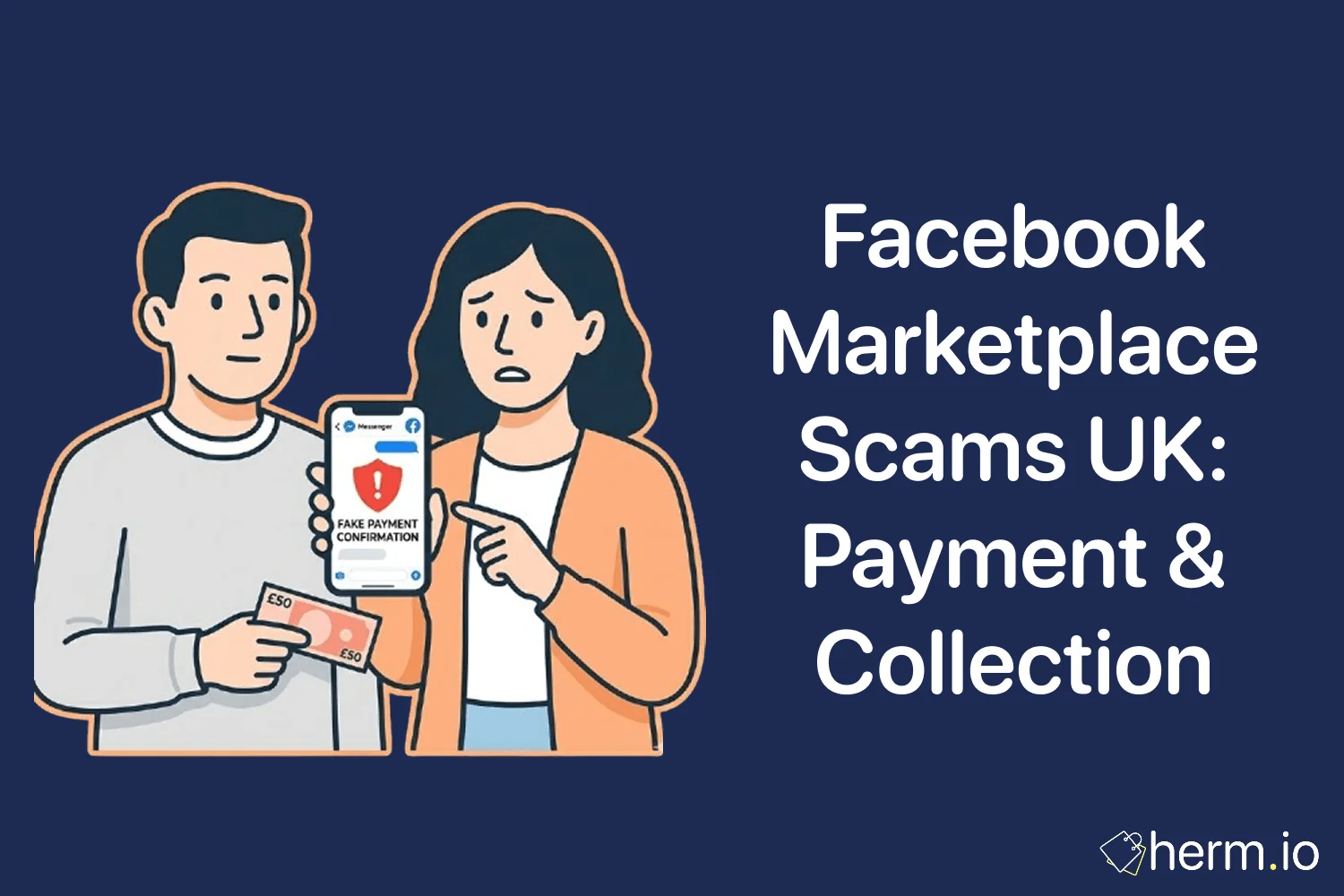
Facebook Marketplace scams UK buyers and sellers face usually work because one part of the deal is unverifiable: the item, the payment, or the person collecting. From a security perspective, that is the whole threat model.
A £40 deposit for a sofa that does not exist, a fake banking screenshot for a games console, or a courier link that asks for card details all use the same tactic: pressure before proof. This guide gives you a safer collection and payment system you can use before money or goods move.
Quick Wins: Start Today
Verify before you pay
See the item in person, or ask for a fresh photo or video that proves it exists before sending money.
Keep the chat inside Facebook
Do not move to WhatsApp, email or text just because the other person says it is easier.
Check your own account
Sellers should trust only their own banking or PayPal app, not screenshots, emails or the buyer's phone.
Avoid risky payment shortcuts
Treat PayPal Friends and Family, gift cards, crypto and courier fee links as stop signs for stranger-to-stranger deals.
How Facebook Marketplace Scams UK Deals Usually Work
Most scams on Facebook Marketplace are not technically clever. They are process failures. Someone asks you to change the normal order of a safe deal: inspect, agree, pay, collect.
The common patterns are familiar once you know what to look for. A fake seller asks for a deposit before viewing. A fake buyer sends a payment screenshot. A courier scammer sends a link for insurance or release of funds. A phishing message asks for a login code to prove you are real.
MoneyHelper warns that scammers may use fake payment confirmations, unusual payment requests, overpayments and fake messages on online marketplaces. It also tells sellers to check that money is actually in their account before continuing with a sale.
The core rule
Do not release money or goods while the other side controls the evidence. Your proof should come from your own eyes, your own bank app, your own PayPal account, or the physical item in front of you.
High-risk categories deserve more checks. Phones, laptops, bikes, e-bikes, designer bags, trainers, event tickets, gift cards, pets and cars all attract fraud because they are valuable, portable or hard to verify quickly.
The Buyer Checklist Before You Travel
Buying safely starts before collection. If the listing looks wrong from your sofa, it will not become safer once you are standing outside someone else’s house with cash in your pocket.
Use this pre-collection checklist:
- Compare the price with similar listings on Facebook Marketplace, eBay UK and Gumtree.
- Check whether the seller profile looks established and local.
- Ask one or two questions a real owner should answer easily.
- Request a fresh photo if the item is expensive or the pictures look copied.
- Refuse deposits for items you have not seen.
- Confirm the collection area, payment method and price in writing.
- Tell someone where you are going, especially for higher-value items.
A cheap price is not proof of a scam, but it changes the risk calculation. If a nearly new iPhone, PlayStation or designer bag is listed far below normal UK resale prices, slow the deal down.
Check the profile, then the product
Look for signals that match a real person selling a real item. A profile with no history, a strange name, several duplicate listings in different towns, or a seller who avoids direct questions should make you pause.
For electronics, ask whether the item is unlocked, reset and free from account locks. For bikes, ask for the frame number. For furniture, ask for measurements, condition issues and whether it can be dismantled.
For cars, do not treat a Facebook listing like a retailer advert. Check the MOT history, V5C details and seller address, and consider a paid vehicle history check before transferring serious money.
Choose the collection point deliberately
For small valuable items, a public, well-lit place is safer than an isolated doorstep. A supermarket entrance, busy café area or location with CCTV gives both sides a cleaner handover.
For bulky items from a home, take another adult if you can. Keep your phone charged, share your live location with someone you trust, and do not carry more cash than you are comfortable losing.
If the seller changes the address at the last minute, asks you to meet somewhere odd, or refuses reasonable inspection, leave the deal. Your time is cheaper than a bad payment.
Safe Payment Methods, Ranked by Risk
Payment choice is the control layer of the whole transaction. The safest option depends on whether you are buying or selling, whether the item is collected or posted, and whether any platform protection applies.
Payment risk comparison for Facebook Marketplace deals
| Payment method | Best use | Main buyer risk | Main seller risk |
|---|---|---|---|
| Cash on collection | Lower-value local items after inspection | Personal safety and counterfeit notes | Counting errors and high-value cash risk |
| Bank transfer | In-person collection after checks | Hard to reverse if the seller disappears | Fake screenshots or pending-payment pressure |
| PayPal Goods and Services | Posted items where both sides accept the rules | Eligibility and evidence can matter | Disputes or chargebacks if records are weak |
| PayPal Friends and Family | People you genuinely know | No PayPal Buyer Protection for purchases | Less risk for seller, high risk for buyer |
| Gift cards or crypto | Not suitable for Marketplace strangers | Very hard to recover | Usually a scam signal |
Cash can be sensible for a £15 bedside table. It is less sensible for a £900 laptop collected alone from a car park.
Bank transfer can be convenient, but the buyer should not send it before inspection. The seller should not hand over the item until the money appears in their own account.
Bank transfer: useful, but not casual
UK reimbursement rules for authorised push payment scams changed in October 2024. The Payment Systems Regulator says in-scope APP scam claims are usually reimbursed within five business days, with a maximum claim of £85,000 and a possible excess of up to £100.
That does not make bank transfer a risk-free payment method. You still need to pay attention to bank warnings, use the correct account details and act quickly if you believe you have been scammed.
Defence in depth means you do not rely on a refund process as your first line of protection. Inspect first, pay second, keep evidence throughout.
PayPal: choose the right payment type
PayPal Goods and Services is designed for purchases. PayPal Friends and Family is designed for personal payments between people who know each other.
PayPal’s UK help pages say Friends and Family payments are not covered by PayPal Buyer Protection, and that you should refuse if a seller asks you to use it for goods or services. That is direct enough to build into your rule set.
A simple payment script
If a seller asks for PayPal Friends and Family, reply: “I only use Goods and Services for purchases from people I do not know. I am happy to cover the appropriate fee if that keeps the transaction properly recorded.”
The Seller Checklist Before You Release an Item
Sellers get scammed because they want the item gone and the buyer knows it. The defensive habit is simple: the item leaves after verified payment, not after a convincing story.
Before the buyer arrives, set the terms clearly:
- Confirm the item, price and collection time in Messenger.
- Say which payment methods you accept.
- Refuse courier arrangements that require you to click links or pay fees.
- Do not give out one-time passcodes, banking details beyond what is needed for a transfer, or card details.
- Remove personal data from phones, tablets, laptops and smart devices.
- Keep another adult nearby for high-value or bulky items.
Avoid buyers who overpay, ask for your email address to send a payment confirmation, or send a courier because they are supposedly too busy. Those patterns appear repeatedly in marketplace fraud reports.
The five-step handover flow
Use a fixed handover flow so you do not have to improvise under pressure.
- Let the buyer inspect the item.
- Agree the final price.
- Take the payment.
- Verify the payment in your own account.
- Release the item only after step four is complete.
If the buyer says the transfer is pending, wait. If they say their banking app shows it has gone, wait. If they become annoyed because you will not accept a screenshot, end the sale.
For posted items, use tracked and insured delivery where the item value justifies it. Keep photos, receipts, tracking and the original listing until you are confident the transaction is settled.
Scam Signals That Should Stop the Deal
You do not need courtroom-level proof that someone is a scammer. A private sale is voluntary; enough doubt is enough reason to walk away.
Stop the deal if you see these signals:
- The price is far below normal UK resale value.
- The seller asks for a deposit before viewing.
- The buyer or seller pushes you away from Facebook Messenger.
- The account is new, blank or inconsistent.
- The photos look like stock images or copied images.
- The seller refuses fresh photos, a video or basic questions.
- The buyer sends a fake-looking payment confirmation.
- The buyer overpays and asks for money back.
- Anyone asks for a one-time code, password or card details.
- A courier link asks you to pay insurance or release funds.
- Someone becomes aggressive when you slow the process down.
One signal can have an innocent reason. Three signals together are a system failure.
What to Do If Money or Goods Have Gone
Act quickly if you think you have been scammed. Do not keep negotiating with the scammer while evidence disappears.
Follow this process:
- Take screenshots of the listing, profile, messages, payment details and any courier links.
- Contact your bank or payment provider using the number on your card or inside the official app.
- Tell the bank clearly if you believe it is an authorised push payment scam.
- Report the listing, account and messages to Facebook.
- Report the fraud through the appropriate UK route.
- Change passwords and enable two-factor authentication if you clicked a suspicious link or shared a code.
For England, Wales and Northern Ireland, Report Fraud can be used to report fraud or cyber crime. If you live in Scotland, or the crime happened there, Report Fraud directs you to contact Police Scotland on 101.
Keep the evidence even if you feel embarrassed. Good records give your bank, PayPal, Facebook and police reporting services a clearer incident trail.
Facebook Marketplace Buyer Protection in the UK
The safest assumption is that local Facebook Marketplace deals have limited built-in protection. Facebook’s Purchase Protection policy says purchases made through third-party sites, local pick-ups, local deliveries, Messenger transactions or other messaging services do not qualify.
That matters because many UK Marketplace deals are exactly that: Messenger chats followed by local collection. If you pay outside an eligible protected checkout, your practical protection sits with your payment method, your evidence and the speed of your report.
Citizens Advice also notes that private sellers have lighter obligations than business sellers, although they must describe items accurately. In plain English: buying a used kettle from a neighbour is not the same as buying a new one from Argos or John Lewis.
This is why the safest Marketplace habit is verification before trust. See the item. Check the payment. Keep the messages. Refuse shortcuts.
Frequently Asked Questions
For local collection, inspect the item first and pay only when you are ready to take it away. Cash can suit low-value items, while bank transfer should be used only after checks and never because a seller is rushing you.
Treat deposits as high risk unless you know the person or have a strong reason to trust the arrangement. For strangers, a deposit before viewing is one of the easiest ways to lose money on an item that may not exist.
Do not hand over the item until you can see the payment in your own bank or PayPal account. Screenshots, emails and pending-payment claims are not proof that you have been paid.
It is not safe for purchases from strangers because PayPal Buyer Protection does not cover Friends and Family payments. Use it only for real friends or family, not for a seller you met through a listing.
The Safer Marketplace Habit
Facebook Marketplace scams UK shoppers and sellers face are easier to avoid when you treat every deal like a small security process. The goal is not suspicion for its own sake. The goal is proof before commitment.
For buyers, that means checking the profile, viewing the item, testing it where possible and choosing a payment method that matches the risk. For sellers, it means refusing fake proof, checking your own account and keeping the item until payment is confirmed.
The best deal is not the one that moves fastest. It is the one where the item, payment and person all check out before anyone loses control of their money or goods.

Written by
Oliver James Whitmore
Contributor
I'm a security expert specializing in privacy, systems architecture, and cybersecurity. With experience across startups and large enterprises, I build resilient, user-centric security systems.
More from OliverRelated Articles
One4all Gift Card Online: Spend It Safely
Use a One4all gift card online safely: find UK retailers, check your balance, avoid declined payments and protect card details.
Cashback Subscription Trap: Spot Checkout Red Flags
Spot a cashback subscription trap after checkout, recognise Complete Savings charges, and stop hidden online shopping fees fast.
Complete Savings Legit? Cancel the Charge Safely
Complete Savings legit? Learn what the £18 charge means, how to cancel safely, and how to ask for a refund without paying a third party.