Amazon Subscribe and Save UK: When It Pays Off
Use Amazon Subscribe and Save UK wisely: compare unit prices, avoid filler orders and stop repeat deliveries before they cost more.
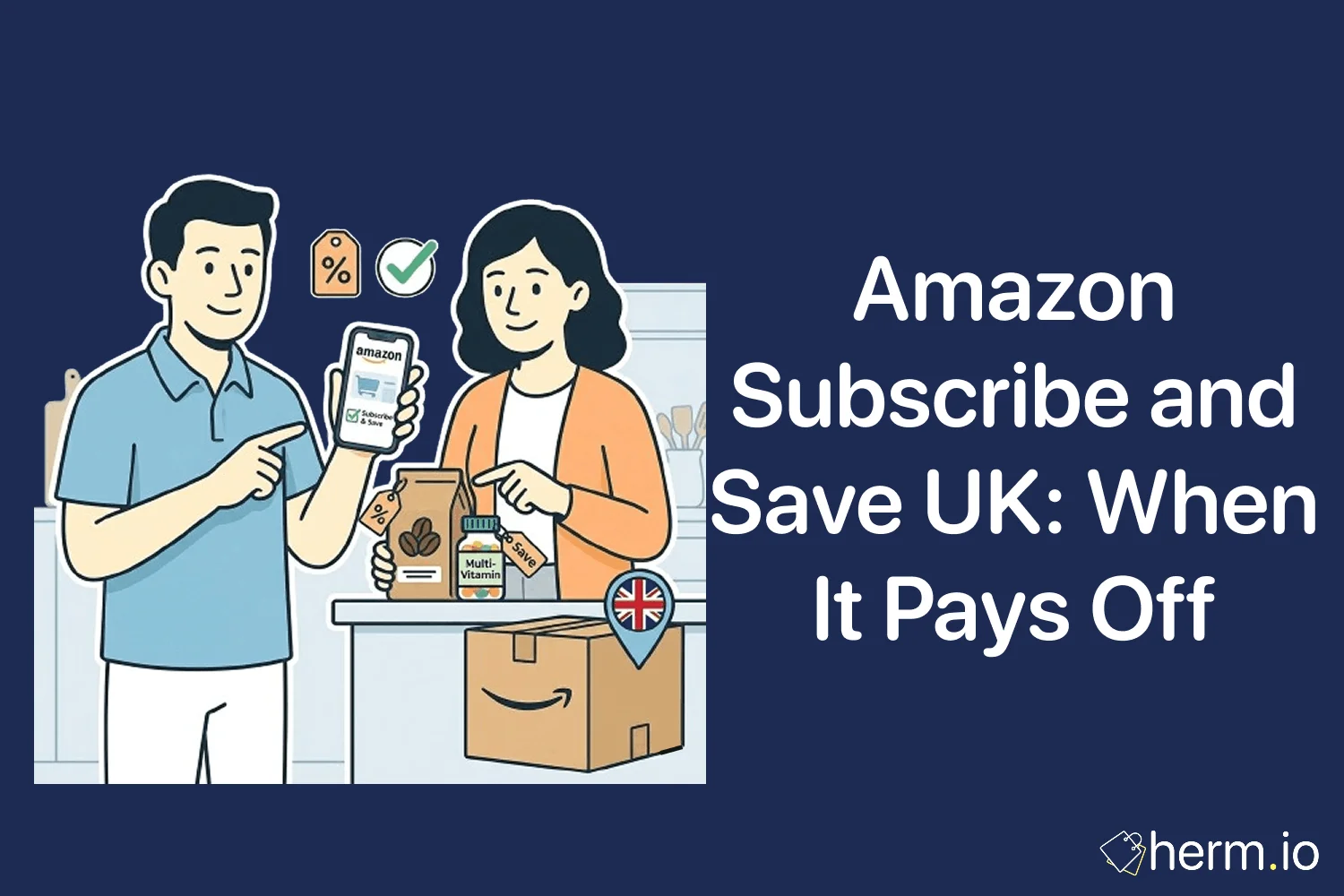
Amazon Subscribe and Save UK works best when you treat it as a repeat-buy system, not a discount button. The mistake is assuming 5%, 10% or 15% off always means the cheapest price.
Here is the practical rule I use: subscribe only when the after-discount unit price beats Tesco, Sainsbury’s, ASDA, Morrisons, Boots, Superdrug, Aldi or Lidl on something you would buy anyway. If it needs a reminder, a price check and a quick cancellation plan, build those in before the first order lands.
Quick Wins: Start Today
Compare the unit price
Check the price per wash, kg, tablet, wipe or roll before you subscribe.
Check two UK retailers
Compare Amazon with at least two supermarkets or chemists before calling it a deal.
Start with a longer gap
Choose a slower delivery schedule first so you do not build a stockpile by accident.
Review before dispatch
Use Amazon's reminder email as your trigger to skip, change or cancel the next order.
How Amazon Subscribe and Save UK Actually Works
Amazon Subscribe and Save is a repeat delivery option for eligible products on Amazon UK. You choose an item, set the quantity, pick a delivery frequency, and Amazon sends it again on that schedule.
The appeal is obvious. Nobody wants to run out of dog food on a Sunday night or carry a tower of toilet roll through the rain.
The risk is just as obvious once you strip away the discount language. A repeat order keeps spending in motion, so your job is to make sure each delivery still earns its place.
What You Are Signing Up To
You are not joining a fixed-price buying club. You are setting up automatic repeat orders for selected products, usually with a Subscribe and Save discount applied at the time that order is processed.
Amazon’s own Subscribe & Save terms describe the discount as applying to the then-current purchase price. That phrase matters because it means the price can move between your first order and your next one.
Use it for repeat essentials, not wishful shopping. If you would not put the product on a normal shopping list, it should not be on a subscription list.
Why Prime Is Useful but Not Always Required
You do not normally need Prime simply to use Subscribe and Save. Some items may have Prime-specific offers or restrictions, but the repeat delivery service itself is not just a Prime membership perk.
Amazon’s order guidance says repeat deliveries get free standard delivery to the UK and Ireland. Non-Prime shoppers may still see delivery costs on the first order if it falls below the free shipping threshold, so check the checkout page rather than guessing.
That is the first control point. A small first-order delivery charge can weaken a deal that looked good on the product page.
The Saving Test: Unit Price Beats Discount Badges
Discount badges are useful signals, but they are not proof of value. The only number that matters is the final unit price after discount, voucher and delivery.
If Amazon shows a cheaper price per tablet, wipe, kg or 100ml than the retailers you actually use, the deal has legs. If it only looks cheaper because the pack size is bigger or the badge is brighter, leave it.
Start With the Real Unit Cost
Run the calculation before you subscribe. This takes about a minute and saves you from paying extra for a product that merely looks discounted.
Use the right unit for the product:
- Dishwasher tablets: price per tablet
- Laundry liquid or capsules: price per wash
- Pet food: price per kg
- Baby wipes: price per wipe
- Shampoo and shower gel: price per 100ml
- Coffee: price per 100g, pod or serving
- Toilet roll: price per roll, and per sheet if the pack sizes vary
Here is a simple example. If a pack of 100 dishwasher tablets costs £12 after Subscribe and Save, that is 12p per tablet. If a supermarket offer gives you 90 comparable tablets for £9.90, that is 11p per tablet, so Amazon loses even with the discount.
Check Supermarkets Before Amazon Renews
Your comparison set should be realistic. If you shop at Tesco and Boots every week, compare Amazon with Tesco and Boots first; if you use Aldi and Home Bargains, they belong in the check.
Look at loyalty prices as well. Tesco Clubcard Prices, Sainsbury’s Nectar Prices, Morrisons More Card offers, Boots Advantage Card deals and Superdrug member prices can all beat a neat-looking Subscribe and Save discount.
I would not spend twenty minutes checking every shop for a £3 product. For pet food, nappies, laundry detergent, razors, coffee and supplements, the savings or losses can add up fast enough to justify the check.
Claire's price rule
If the item costs more than you would normally compare in-store, compare it online before it repeats. Pet food, nappies, washing capsules and razors are the first products I would audit.
When Subscribe and Save Is Worth Using
Subscribe and Save earns its keep when it removes friction from a purchase you already make and gives you a better price than your usual alternative. Convenience counts, but it should not hide weak pricing.
👍 Pros
- Useful for regular essentials
- Convenient for bulky products
- Can stack with selected first-order vouchers
- Easy to skip or cancel before processing
👎 Cons
- Original price is not locked
- Can encourage unnecessary repeat spending
- Supermarket promotions may be cheaper
- Filler items can wipe out the saving
Regular Branded Essentials
The strongest use case is a branded product you buy again and again. Dog food, nappies, dishwasher tablets, washing capsules, razors and contact lens solution can all fit this pattern.
Brand loyalty is the deciding factor. If you are happy to swap to a cheaper own-brand product, Amazon may not be the best benchmark.
Bulky Products You Hate Carrying Home
Large packs can be worth paying attention to even when the cash saving is modest. Toilet roll, drinks, cat litter and laundry products are classic examples.
A fair decision includes both price and effort. If Amazon is within a few pence per unit and saves you carrying 10kg of pet food home, that may still be a good outcome.
First-Order Vouchers With a Cancel Plan
Some items show extra first-delivery vouchers or limited-time discounts. These can make the first order attractive, especially on products you would buy anyway.
MoneySavingExpert has highlighted that shoppers can cancel after the first Subscribe and Save order if they only wanted the initial saving. Treat this as a controlled tactic, not a habit; make a note to cancel once the parcel arrives if you do not want the repeat order.
When to Avoid Amazon Subscribe and Save UK
Avoid Subscribe and Save when the subscription creates spending you would not have made, or when the product price moves too often for comfort. The bigger the pack and the shorter the delivery gap, the more disciplined you need to be.
Price Changes Can Erase the Deal
This is the main caveat: Amazon Subscribe and Save does not lock the first price. Amazon states that prices can change and the amount charged may increase or decrease if the item price changes before processing.
That does not make the service bad. It simply means you need to review each order before it ships.
Do not set and forget
The first order can be excellent and the third order can be poor value. If the product price rises, your discount may still leave you paying more than a supermarket or chemist offer.
Filler Items Are Usually False Economy
Buying an extra item just to push up the discount level can work, but only if you genuinely need that item. Toothpaste, bin bags or soap might be sensible; random snacks or duplicate toiletries usually are not.
Run the decision like this: would you buy the filler today at this price without the subscription discount? If the answer is no, remove it.
Slow-Use Products Create Cupboard Clutter
Some products last longer than expected. Shampoo, cleaning spray, vitamins, sauces, protein powder and skincare can pile up quietly.
This is where Subscribe and Save feels cheap but behaves expensively. Money tied up in products you do not need this month is still money spent.
Your Repeat Order Control System
Implementation requires three steps: slow the schedule, check the reminder, and act before dispatch. No drama, no spreadsheet empire.
Set a Longer Delivery Gap First
If you think you need something every month, start with every two months. If you think every two months is enough, start with three.
You can usually bring an order forward if you are running low. It is harder to reverse a cupboard full of products you bought too soon.
Review Every Reminder Email
Amazon sends reminders before repeat deliveries are processed. Treat that email as a decision point, not a receipt.
Check the product page again, compare one or two retailers, and ask whether you still need the item. This is the five-minute habit that stops the subscription from drifting.
Skip, Change or Cancel Before Dispatch
You can manage subscriptions from the Subscribe and Save area of your Amazon account. Amazon provides separate help pages for changing delivery schedules and cancelling subscriptions.
Use the three options properly:
- Skip if you still want the product later.
- Change the schedule if the timing is wrong.
- Cancel if the price no longer works or the product is not needed.
Do it before the order moves too far into dispatch. Once a parcel is being prepared, cancellation may only stop future deliveries.
Best and Worst Products to Put on Repeat
The best Subscribe and Save products are boring. That is a compliment here.
You want predictable usage, long shelf life, easy unit-price comparison and enough order value for the saving to matter.
Good Candidates for Subscribe and Save
These categories are worth checking first:
- Dishwasher tablets and washing capsules
- Pet food, litter and repeat treats
- Nappies and baby wipes
- Toilet roll and kitchen roll
- Razors and replacement blades
- Deodorant, toothpaste and basic toiletries
- Coffee, tea and other regular cupboard staples
- Cleaning refills and bin bags
Check the exact product, pack size and unit price. A good category does not make every listing a good deal.
Weak Candidates for Subscribe and Save
Be careful with products that are easy to overbuy or replace with cheaper alternatives.
These are the ones I would challenge first:
- Snacks you would not normally buy
- Supplements you use irregularly
- Beauty products that last months
- Short-dated food or drink
- Products where Aldi, Lidl, B&M or Home Bargains own-brand is much cheaper
- Anything added only to reach a higher discount
The test is simple. If it would not survive your normal shopping list, it should not survive your subscription list.
Frequently Asked Questions
Yes, you can usually cancel after the first delivery if you do not want future orders. Set yourself a reminder for the day the parcel arrives so the subscription does not roll on by accident.
No. Subscribe and Save applies a discount to the current price when the order is processed, so the amount can change between deliveries. That is why checking the reminder email matters.
The biggest mistake is chasing a discount rather than checking the unit price. A higher discount on an inflated price can still lose to a supermarket offer or own-brand alternative.
It can be worth it for branded cupboard staples, coffee, pet food and bulky household products. Fresh food, short-dated items and products you buy only when on offer are usually weaker candidates.
The Bottom Line: Use It Like a Tool
Amazon Subscribe and Save UK can save money, especially on regular branded essentials and bulky products you dislike carrying home. It is weakest when you use it as a shopping shortcut without checking the current price.
Your working system is straightforward: compare the unit price, start with a slower schedule, review every reminder email, and cancel anything that stops earning its place. That is how you keep the convenience without letting repeat orders run your budget.
Use it for products you already buy, not products Amazon has persuaded you to repeat. Before your next subscription renews, check one item properly and decide whether it still deserves the slot.

Written by
Élodie Claire Moreau
Contributor
I'm an account management professional with 12+ years of experience in campaign strategy, creative direction, and marketing personalization.
More from ClaireRelated Articles
Gift Card Expiry Dates UK: Protect Your Balance
Gift card expiry dates UK explained in plain English: know your rights, check retailer rules, and protect every unused balance.
Store Credit vs Refund UK: Know Your Rights
Store Credit vs Refund UK: learn when shops can offer credit notes, when you can ask for money back, and how to push politely.
Love2shop vs One4all: Which Gift Card Wins?
Love2shop vs One4all: compare UK retailer choice, online rules, expiry fees, and checkout traps before you buy a gift card.