The CAC-LTV Squeeze: 2026 Is for Profitable Growth
2026 is the year of profitable growth. Understand the CAC-LTV squeeze, why retention drives LTV:CAC, and how to fix unit economics with a clear playbook.
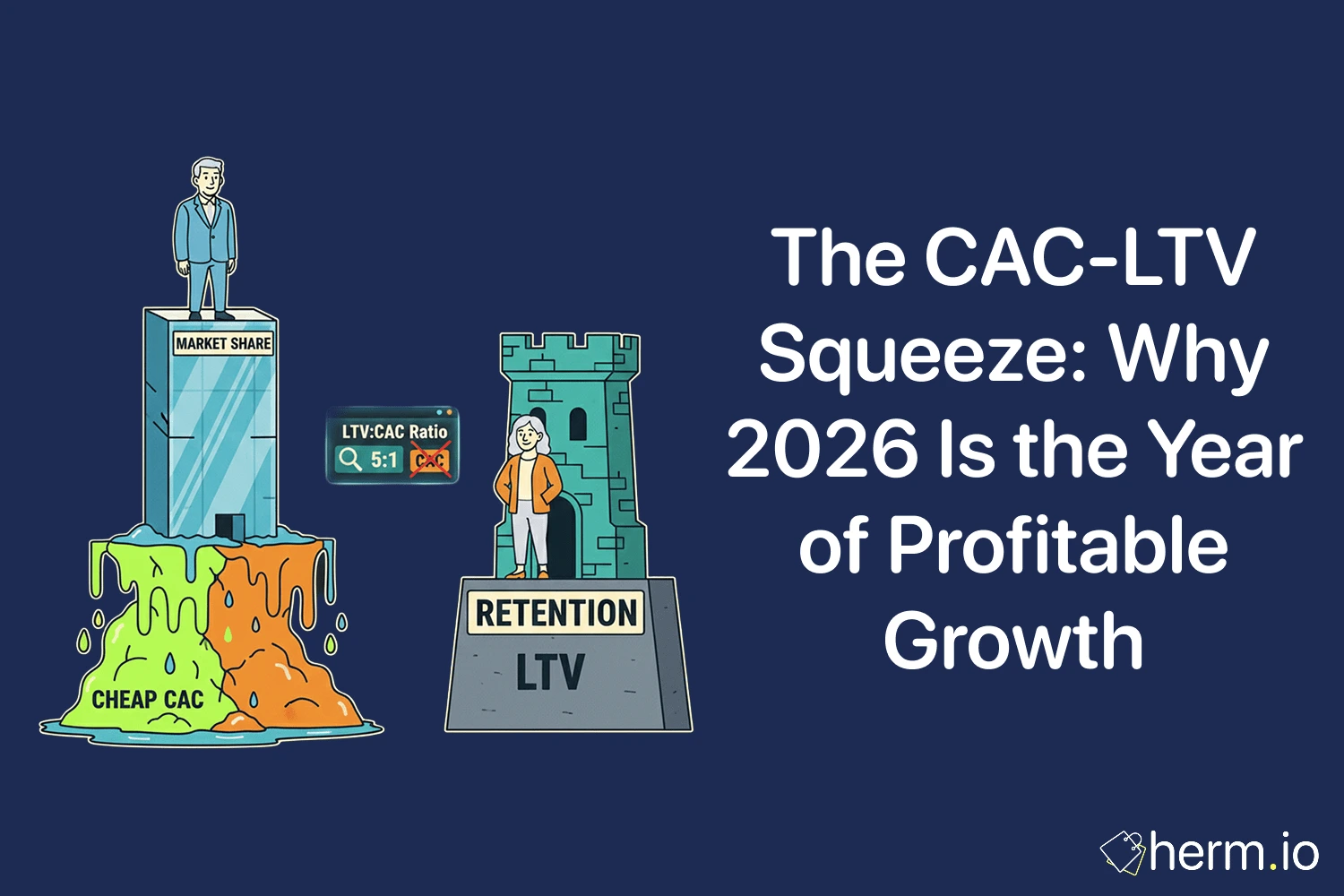
Picture a marketing team celebrating record-low acquisition costs. Dashboards glow green. The CFO nods approvingly. Six months later, that same team watches their customer base evaporate, wondering where everything went wrong.
Blue Apron lived this scenario. In 2018, their CEO told investors: “The challenge for us is more on the acquisition side of the business, not on the retention side… If we can acquire customers in an efficient manner, the retention side shouldn’t be a challenge.”
The numbers tell a different story. Within two years, Blue Apron’s market capitalisation had collapsed by over 95%. The CEO had the equation inverted; most companies still do.
Consider this disparity: a 1% improvement in retention increases company value by 3–7%, while a 1% improvement in acquisition cost moves the needle by just 0.02–0.3%. That represents a 10–100x difference in impact. Yet marketing departments remain fixated on driving CAC downward, optimising the variable with the smallest coefficient.
2026 presents an opportunity to correct this miscalculation.
The Volume Trap
The conventional playbook carries intuitive appeal: acquire customers cheaply, at scale, then sort out retention later. Your customer count climbs. Your CAC looks efficient on quarterly reports. Your board expresses satisfaction.
Then the cohort data arrives.
Professor Daniel McCarthy (now at Robert H. Smith School of Business, University of Maryland) reverse-engineered Blue Apron’s S-1 filing and uncovered a troubling pattern: 62% of customers churned within six months. With CAC climbing to $169 per customer and break-even requiring 8+ months of retention, Blue Apron was losing money on roughly two-thirds of every customer they acquired. They weren’t constructing a business; they were operating an expensive customer rental programme.
Casper followed a similar arc. Professor Scott Galloway observed that while the mattress company poured hundreds of millions into marketing, they couldn’t escape a structural problem: customers purchase a mattress every 7–10 years. “Casper and Away have to pay to generate traffic,” Galloway noted, “while Warby Parker gets nearly 80% of its traffic organically.”
The pattern here is instructive. Cheap acquisition attracts cheap customers. When you optimise for the lowest possible CAC, you systematically select for customers least likely to remain, refer others, or purchase again. Like building a structure on unstable ground, the initial savings disappear when the foundation shifts.
The Ratio That Determines Value
The metric that matters isn’t CAC in isolation. It’s LTV:CAC: the ratio of customer lifetime value to acquisition cost.
Research published in the Journal of Marketing Research examined this relationship across five major companies. The findings demonstrate that retention carries dramatically asymmetric weight compared to acquisition efficiency. A 1% improvement in retention increases customer value by 2.45–6.75%. A 1% reduction in acquisition costs? Just 0.02–0.32%. The researchers determined that retention elasticity runs 3–7x greater than margin elasticity and 10–100x greater than acquisition cost elasticity.
Read those figures again. You could halve your acquisition costs (a substantial achievement) and it would produce less impact than a modest retention improvement.
Investors have taken notice. Analysis by Andreessen Horowitz spanning 60+ public consumer internet companies revealed that improving your LTV:CAC ratio from 2x to 3x can nearly triple your valuation multiple. Companies with 2x ratios trade at roughly 1.5x forward gross profit. At 3x, that figure rises to 5.3x. At 5x, it reaches 8.4x.
The implication is straightforward: identical gross profit pounds are valued 3–5x higher based purely on unit economics efficiency. Markets don’t reward low CAC; they reward the ratio.
This reframes the acquisition conversation entirely. A £500 CAC that yields £2,500 in lifetime value (5:1) proves dramatically more valuable than a £50 CAC yielding £100 (2:1). The “expensive” customer is actually the bargain. Like a well-engineered system, the components that cost more upfront often deliver superior long-term performance.
The Pareto Reality
The 80/20 rule surfaces in every marketing discussion: 80% of revenue derives from 20% of customers. It’s repeated so frequently it’s become reflexive.
It’s also overstated. Recent research published in the Journal of Marketing Management analysed over 200 digital brands across 18 categories and four countries. The actual finding: the top 20% of customers account for 47% of sales on average, not 80%. The range spans 32–70% depending on category.
This nuanced figure proves more useful than the mythical 80/20. Customer value concentration exists and matters; your best customers genuinely deliver multiples of your average customers. Yet the concentration isn’t so extreme that everyone else becomes irrelevant. The “heavy half” of buyers (those purchasing more than the median frequency) drives 71% of sales.
The strategic question becomes: are you acquiring more customers who resemble your heavy half, or flooding your funnel with one-time buyers who will never return? Looking at the data objectively, the answer determines whether you’re building an asset or digging a hole.
What Separates Winners from Casualties
The difference between struggling and thriving companies frequently reduces to acquisition discipline.
Warby Parker, which Galloway predicted would achieve “one of the more successful retail IPOs in recent memory,” maintained consistent LTV:CAC ratios of 2.3–3.2x across cohorts. Unlike Blue Apron, they demonstrated no cohort degradation; customers acquired in later years retained as effectively as early adopters. The difference? They refused to compete on discount or pursue the cheapest acquisition channels. They constructed a brand that generated organic traffic.
Starbucks provides an even cleaner illustration. Their Rewards programme members spend 3x more than non-members. Over 50% of US sales now flow through the programme. Rather than minimising acquisition cost, Starbucks invested in identifying and cultivating high-value customers, then created structural incentives for them to remain.
The pattern remains consistent: winning companies accept higher CAC for better customers, then invest in retention infrastructure to maximise the LTV portion of the equation. They understand that the numerator and denominator work together; optimising one while ignoring the other produces an unstable system.
The 2026 Playbook
Forrester’s 2026 predictions cut directly to the issue: “Disconnected strategies and performative personalisation will no longer earn loyalty. To succeed, leaders must prioritise transparency, relevance, and measurable impact.”
Translation: the era of growth-at-all-costs has concluded. Here’s what works instead.
Know your numbers by segment. Stop measuring blended CAC. Segment your customers by lifetime value and calculate CAC for each tier separately. You’ll likely discover that your “efficient” acquisition channels deliver your worst customers. The aggregate figure conceals more than it reveals.
Build lookalikes from your best customers, not all customers. Most companies seed their prospecting audiences with everyone who ever purchased. Instead, isolate your top 20% by LTV and model your acquisition targeting on their characteristics. You’ll acquire fewer customers at higher CAC, but with substantially better retention. The mathematics favour this trade-off.
Accept higher CAC on channels that deliver quality. The cheapest click rarely converts to the best customer. If a channel costs more but delivers customers with 3x the LTV, that’s not inefficiency; it’s intelligent allocation. Run the full calculation before declaring victory on cost metrics alone.
Invest in retention infrastructure before scaling acquisition. Blue Apron’s CEO had the sequence reversed. You cannot acquire your way out of a retention problem. Build the loyalty programme, the email nurture sequences, the community. Then increase acquisition spending. The infrastructure must exist before you pour volume through it.
Measure success by LTV:CAC ratio, not CAC alone. Make this your primary metric. Report it to the board. Tie compensation to it. When the organisation optimises for the ratio rather than a single variable, behaviour shifts accordingly.
The Most Expensive Customer
Frederick Reichheld’s research at Bain & Company established that a 5% increase in customer retention produces a 25–95% increase in profits, depending on industry. This finding is now 25 years old. Subsequent studies have validated it repeatedly. Yet companies continue pursuing volume over value.
Perhaps because the prescription feels counterintuitive. Perhaps because CAC is simpler to measure than LTV. Perhaps because acquisition metrics generate more excitement than retention metrics in board presentations.
But mathematics doesn’t respond to enthusiasm. And the mathematics here is unambiguous.
The most expensive customer isn’t the one who costs the most to acquire. It’s the one who never comes back.
Sources
Gupta, S., Lehmann, D.R., & Stuart, J.A. (2004). “Valuing Customers.” Journal of Marketing Research, February 2004.
Sullivan, J. & Immerman, A. (2023). “Why Do Investors Care So Much About LTV:CAC?” Andreessen Horowitz. a16z.com
Anesbury, Z., et al. (2025). “Pareto Share analysis of digital brands.” Journal of Marketing Management. Taylor & Francis Online
McCarthy, D. (2017). “Blue Apron’s IPO Filing Implies Troubling Customer Retention.” Medium. Link
Galloway, S. (2020). Analysis of Casper IPO. No Mercy / No Malice.
Reichheld, F. (2001). Loyalty Rules! Harvard Business School Press.
Forrester Research. (2025). “2026 Predictions: B2C Marketing, CX, & Digital.” Forrester.com
Starbucks Corporation. Investor Relations and Rewards programme disclosures.
Disclosure: This article was produced using AI-assisted writing tools. The underlying research was gathered, analysed, and verified by human researchers. Final editorial review, fact-checking, and quality control were performed by human editors.

Written by
Camille Durand
Contributor
I'm a marketing analytics expert and data scientist with a background in civil engineering. I specialize in helping businesses make data-driven decisions through statistical insights.
More from CamilleRelated Articles
Origins of Affiliate Marketing: Pay-for-Performance
Origins of affiliate marketing: a sourced history from Prodigy and PC Flowers to CDnow’s BuyWeb and Amazon Associates, plus tech, timeline, and FTC rules.
Customer Acquisition: Strategic Digital Pathways
Discover how leading brands revolutionise customer acquisition in 2025. AI-driven personalisation, first-party data strategies, and omnichannel frameworks.
Cultivating High-Value Customers: Acquisition Tips
Discover proven strategies for acquiring high-value customers who drive 80% of profits. Advanced segmentation, personalisation, and measurement frameworks.